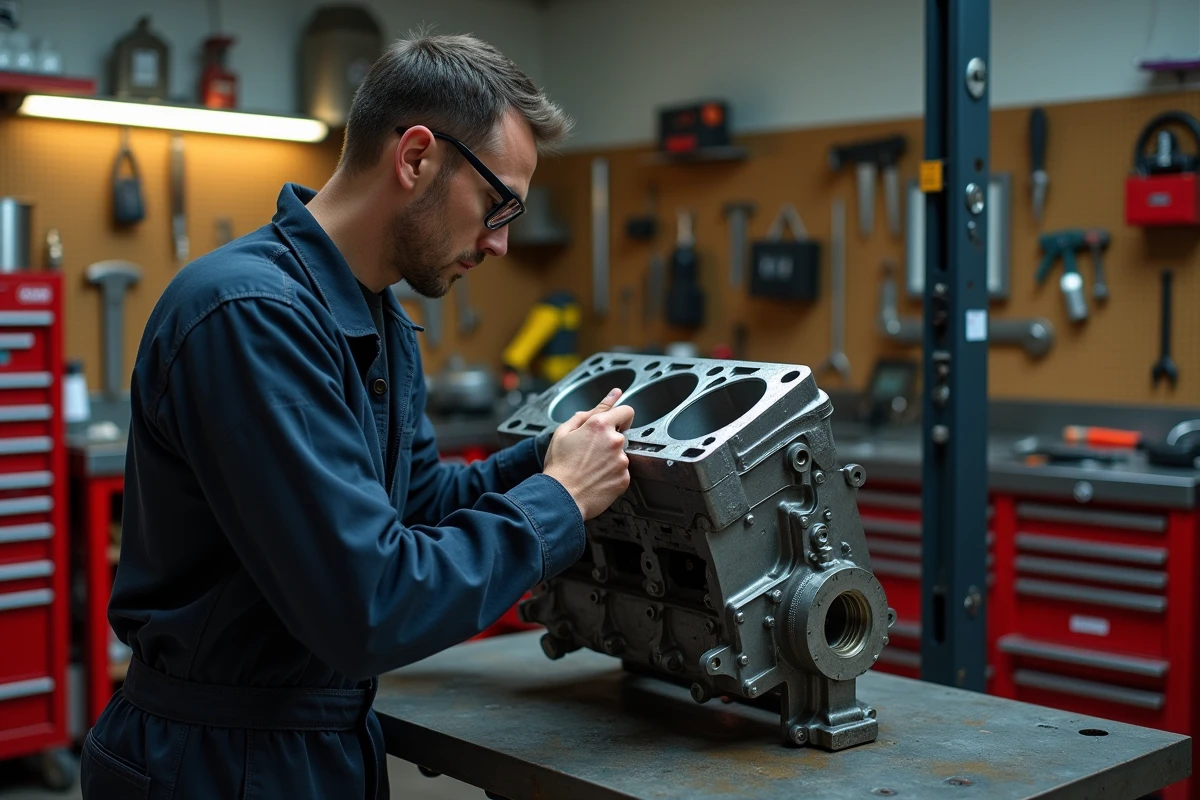
A forged engine block is not just about stronger pistons and connecting rods. The difference lies in the crystalline structure of the metal, its behavior under repeated thermal load, and its compatibility with the rest of the drivetrain. Before spending several thousand euros, it’s better to understand what technically justifies the expense and what is merely marketing.
Grain structure and fatigue resistance: what distinguishes forged from cast
Forging compresses the metal (steel or aluminum depending on the part) under a high-energy press. This plastic deformation aligns the fibers of the metallurgical grain in the direction of mechanical stresses. The result: a fatigue resistance significantly superior to that of a cast part, where the grain remains random and often porous.
On a forged connecting rod made of 4340 steel, the homogeneous density of the material allows it to withstand high RPMs without initiating cracks. Cast or sintered connecting rods, used in production, can handle the stresses of a stock engine. As soon as we increase the boost pressure or RPM, the micro-porosities of the casting become points of failure.
We observe the same phenomenon with pistons. A forged piston made of 2618 or 4032 aluminum maintains its dimensions under temperatures that cast pistons cannot tolerate. The 4032 alloy, richer in silicon, offers reduced thermal expansion but is more brittle. The 2618, being more ductile, better absorbs thermal shocks, at the cost of a wider piston-cylinder clearance when cold, leading to increased noise at startup.
To accurately assess the price of a forged engine block, one must factor in the cost of each forged component, as well as the peripheral adaptations that these parts impose.
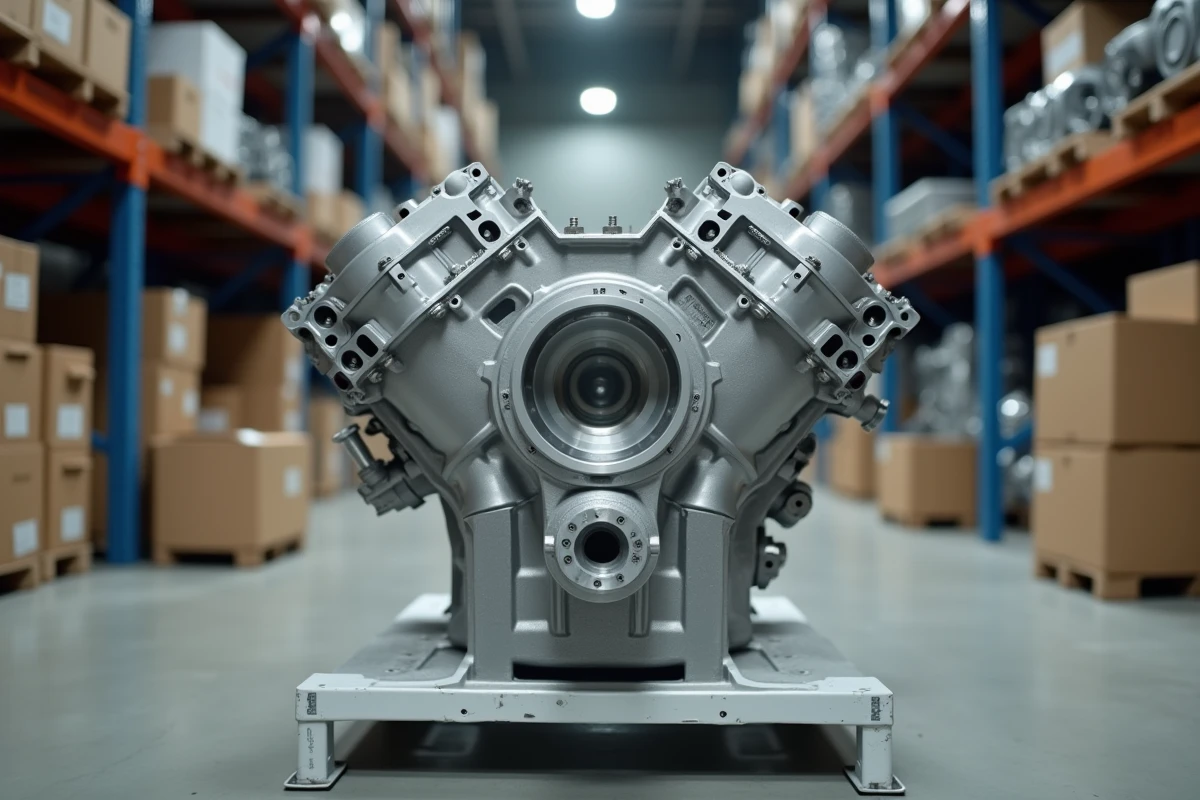
Forged engine block: the mechanical adaptations that the budget must include
Replacing connecting rods and pistons with forged parts without addressing the rest of the engine is a common mistake. A poorly integrated forged kit can create more problems than a well-maintained stock engine.
The crankshaft endures different loads with stiffer connecting rods. On a modified turbo engine, switching to a forged steel crankshaft (instead of the original ductile iron) often becomes essential. Add to that a lightweight flywheel, suited to the new inertia profile, and a reinforced clutch capable of transmitting the additional torque.
Peripheral components to consider
- Tri-metal crankshaft bearings (copper-lead-tin), more tolerant of high loads than the original bi-metal ones
- ARP or equivalent head studs, to ensure uniform clamping under high combustion pressure
- Multi-layer steel (MLS) head gasket suited to the new target boost pressure
- Increased flow oil pump, because forged parts require a constant oil film at high RPM
These often underestimated items represent a significant portion of the total budget. Forging connecting rods and pistons without replacing the head studs is like building a solid bridge on fragile foundations.
Longevity and maintenance of a forged engine in daily use
A forged engine is not an endurance engine by default. Its lifespan directly depends on usage and maintenance rigor. Forged parts tolerate stress peaks better, but not negligence.
The wider piston-cylinder clearance (necessary with a 2618 alloy) implies slightly higher oil consumption when cold. Oil change intervals must be shortened, especially on an engine subjected to track sessions. We recommend an oil viscosity suited to the actual thermal profile of the engine, not the one from the manufacturer’s maintenance manual.
On the road, a forged engine may be less refined than a stock block. Cold knocking, increased operational noise, and a drier response at low RPM are compromises accepted in tuning, but they may be off-putting in daily use. A Renault F4R engine forged for track days does not behave like the original engine on a home-to-office commute.
Price of a forged engine block: where the budget really goes
The cost of a forged kit (connecting rods, pistons, pins) varies greatly depending on the type of engine, the chosen alloy, and the manufacturer. Recognized brands in the automotive field (Mahle, Wiseco, CP-Carrillo, Pauter) apply prices that reflect the quality of forging and dimensional tolerances.
The parts kit rarely represents more than half of the total cost. Labor for assembly, dynamic balancing of the bottom end, potential machining of the sleeves, and replacement of peripheral components inflate the bill.
Typical budget breakdown
- Forged kit (connecting rods + pistons + pins): the most visible item, but not the most expensive once everything is added up
- Forged crankshaft (if necessary): a significant item, sometimes equivalent to the connecting rod-piston kit
- Small critical parts (studs, bearings, MLS gaskets, ARP fasteners): a budget often overlooked that can reach several hundred euros
- Labor and balancing: depends on the tuner, access to the block, and the number of machining hours
A reinforced clutch and an adapted flywheel are added if the output torque exceeds the capabilities of the original transmission.
The most common trap is to budget only for the forged kit without anticipating the adaptations. A well-assembled forged engine block correctly integrated into its drivetrain offers a real reliability margin under heavy load. But this margin only exists if each link, from the bearings to the head gasket, has been sized accordingly.