We often come across the question when picking up a used scooter or planning a commute: what document do we actually need to ride a 125 cm³ in France? The answer depends on the date of obtaining the B license, the type of vehicle in question, and for foreign residents, the recognition of their driving title.
B License and 125 cm³: the issuance date changes everything
Before looking for a motorcycle or scooter, it’s important to check a specific point on the B license: the date listed in box 4a. This date determines whether additional training will be necessary or not.
Holders of a B license obtained before March 1, 1980 can ride a light motorcycle 125 cm³ without any additional steps. No training, no mention to add to the title. Just get on the bike, end of story.
For a B license issued after this date, two cumulative conditions apply: having at least two years of experience with the B license, and then completing a practical training of 7 hours at an accredited driving school. To know precisely whether a license is needed to ride a 125, this combination of experience and training remains key.
The 7-hour training does not lead to an exam. It consists of theoretical modules and practical riding. The certificate issued at the end of the day is sufficient to have the mention added to the license.

A1 License, 7-hour training or A2 License: choosing the right path to ride a light motorcycle
The A1 license and the 125 equivalence via the B license are often confused. Both allow access to the same machines, but the process is quite different.
The A1 License from age 16
The A1 license is a real motorcycle license. It requires a theoretical test (the motorcycle code) and a practical exam including a maneuvering course and a road test. It allows the riding of motorcycles up to 125 cm³ and 11 kW, as well as tricycles up to 15 kW.
This is the only option before age 18 to ride a 125. A 16-year-old minor cannot rely on a B license that they do not yet possess.
The 7-hour training for B license holders
This is the most common shortcut. It is accessible with a B license of more than two years. The training usually takes place over one day, sometimes spread over two days in Île-de-France where the maneuvering slots are harder to obtain.
- 2 hours of theory covering road safety specific to two-wheelers, blind spots, and positioning on the road
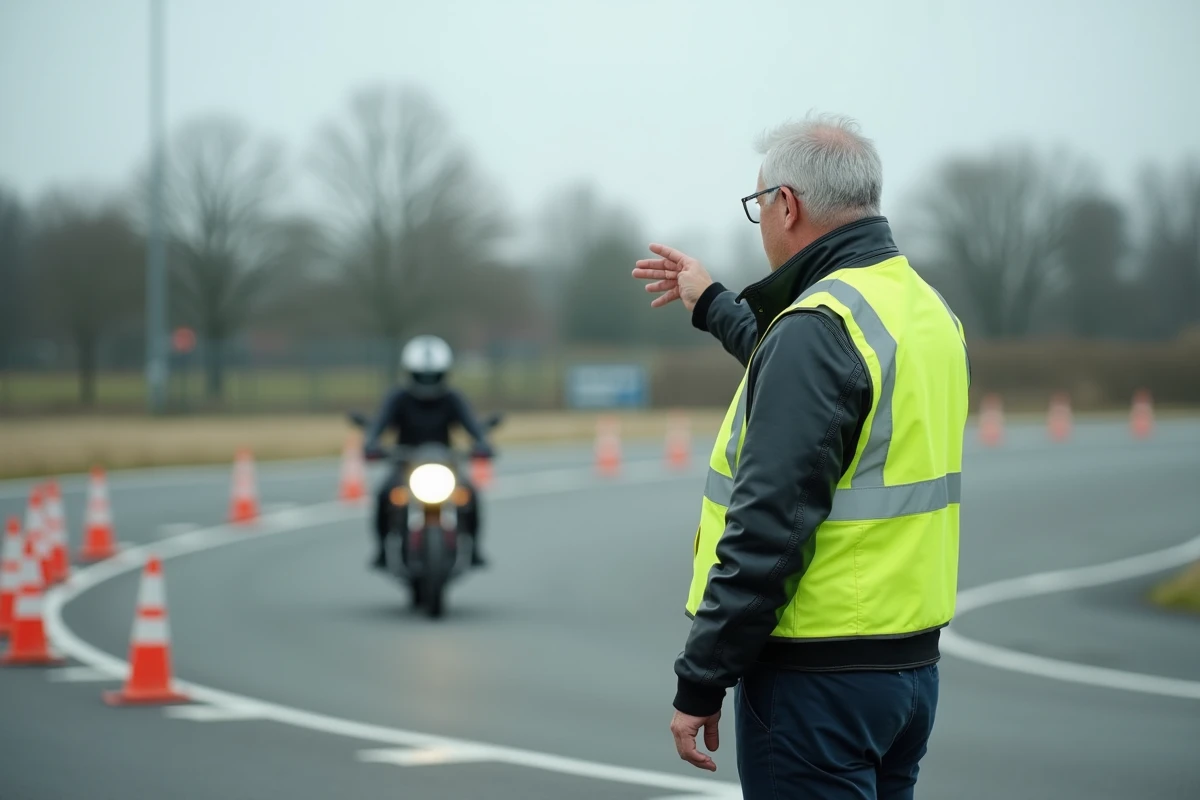
- 2 hours of practical training off the road to master balance at low speeds, braking, and basic maneuvers
- 3 hours of riding in real traffic to understand traffic, intersections, and cohabitation with other users
The cost varies depending on driving schools and the region. No CPF funding is available for this specific training, unlike the complete A2 license.
Why some go directly for the A2 license
If one plans to ride later on medium-displacement motorcycles, the A2 license immediately covers the 125 cm³ in addition to machines up to 35 kW. The investment in time and budget is heavier (motorcycle code, driving hours, maneuvering and road exams), but it avoids having to go through further training to increase power.
European cross-border workers and foreign B licenses: the pitfalls in France
This is a case that competitors rarely address, yet it concerns thousands of cross-border workers. Can a Belgian, Luxembourgish, or German resident holding a B license from their country ride a 125 cm³ on French territory with the same logic as the French?
Theoretically, driving licenses issued in the European Economic Area are mutually recognized. A Belgian B license is valid in France to drive a car. But the 125 cm³ equivalence via the B license is not harmonized at the European level. Each country applies its own rules for access to light motorcycles.
In Belgium, for example, a B license issued before a certain date directly grants access to 125 cm³ without training. In France, this Belgian exemption is not recognized. A Belgian cross-border worker who has been living in France for more than six months and has exchanged their license for a French title will have to undergo the 7-hour training like any holder of a French B license, even if they were legally riding a 125 back home.
For short-term residents or European tourists, the responses vary on this point. In case of a check, the situation may lead to discussion if the foreign license does not carry an explicit A1 or equivalent mention. In practice, it is recommended to carry the training certificate from the country of origin if it exists, or to undergo the French training before regularly riding.
- Check if the foreign B license has an explicit A1 or B1 mention
- Contact the prefecture of the place of residence to know the conditions for exchanging licenses
- Anticipate the 7-hour training in France if no equivalence is recognized
Three-wheeled scooters and B license: a separate regulation
Three-wheeled scooters like the Piaggio MP3 attract many B license holders, especially for their stability in the city. Access depends on the vehicle’s power and the driver’s age.
A tricycle over 15 kW requires being at least 21 years old and having held a B license for more than two years, along with the 7-hour training. For models of 15 kW or less, the rules are the same as for classic 125 cm³.
It should be noted that three-wheelers do not fall into the A1 category in the strict sense. They fall under a specific mention on the B license. This distinction has implications for insurers, who sometimes apply different rates than those for a two-wheeled scooter of equivalent displacement.
The B license remains the most common key to accessing 125 cm³, provided that the required experience is respected and the 7-hour training is completed. For cross-border workers, caution is advised: checking the recognition of their title before hitting the road avoids a ticket and a confiscated vehicle.