
Blogs run by parents number in the thousands in the French-speaking blogosphere. Their promise often boils down to one sentence: sharing tips to simplify family life. Behind this apparent lightness, the question deserves closer examination. Does a family blog produce a measurable effect on the organization of daily life, or does it remain a space of occasional comfort with no real impact on parental burden?
Parental mental load: what blogs address and what they ignore
Most family blogs focus their articles on visible aspects of domestic organization: planning weekly meals, optimizing a shopping list, preparing for the school year. These contents meet an immediate need, but they cover only a fraction of what weighs on parents.
The Ifop barometer for News RSE published in 2025 shows that working women in couples report much more often carrying the bulk of the family load than men. This load is not limited to household chores. It includes children’s medical follow-up, communication with the school, administrative management, and coordination of extracurricular activities.
A blog that merely provides a chore distribution chart misses the point. The most useful content is that which addresses the distribution of complete responsibilities (health, schooling, procedures, activities) rather than a simple division of chores. Some online spaces are beginning to tackle this angle, such as the family blog on Diboo that caters to overwhelmed parents with a more holistic approach to daily life.

Screens and digital school tools: a field where blog advice diverges
Articles about children’s screen time are among the most consulted on parenting blogs. For a long time, the dominant recommendation boiled down to a daily time threshold. Recent guidelines are changing the perspective.
The current approach prioritizes sleep quality, physical activity, and the nature of content rather than a minute counter. The Enabee study from Santé publique France and the recommendations relayed by Information Jeunesse LR go in this direction. A family blog that repeats “no more than two hours a day” without nuance applies an outdated framework.
School platforms and attention fragmentation
A report from the General Inspectorate of Education, Sports, and Research published in June 2025 highlights a paradox. The proliferation of school platforms and notifications can increase stress in the relationship between schools and families instead of simplifying it. Pronote, ENT, class messaging, cafeteria apps: the channels overlap.
A family blog that addresses this issue concretely can propose operational rules:
- Define a fixed time slot for checking school platforms (for example, in the evening after dinner) rather than reacting to each notification in real-time
- Disable non-urgent alerts on educational apps to reduce interruptions during the workday
- Explicitly divide the monitoring of each platform between the two parents, avoiding one parent concentrating all digital oversight
This type of content goes beyond the simple advice of “limit screens.” It tackles a source of cognitive fatigue that many parents struggle to identify.
Family blog and protecting children’s image: a rarely addressed angle
Sharenting (the act of posting photos or stories about one’s children online) directly concerns family blogs, as many bloggers illustrate their articles with photos of their own families. The legal dimension of this practice remains little addressed in parenting content itself.
The French legislative framework is evolving towards strengthening minors’ image rights. The principle of protecting children’s image rights also applies to family blogs, not just to high-audience social networks. A blog that advises parents to document their family activities online should also address the precautions to take: blurring faces, age-appropriate consent, privacy settings.
Field feedback varies on this point. Some bloggers believe that their limited audience exempts them from these precautions. However, image rights do not depend on visitor numbers, and content indexed by search engines remains accessible well beyond the initial circle of readers.
Concrete limits of a family blog for daily organization
A blog remains a passive medium. The reader consumes an article, takes away an idea, and then returns to their daily life. The gap between reading advice and putting it into practice depends on the family context, household configuration, number of children, and professional constraints.
The contents that work best in terms of practical application share a few characteristics:
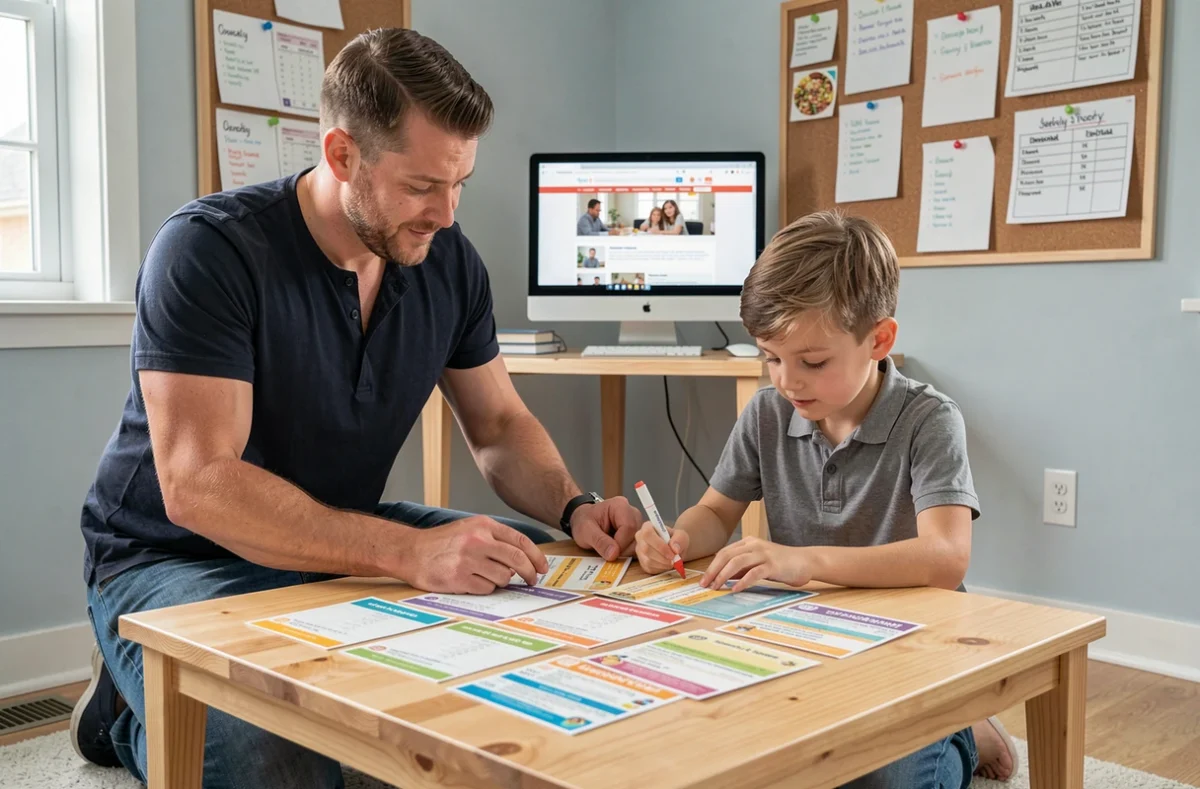
- They offer a directly usable tool (a family budget template, a printable weekly care schedule) rather than a general principle
- They describe a specific situation with its constraints, not an ideal household with two available parents and flexible hours
- They mention the limits of the proposed method, including cases where it does not work
The question of source reliability
A family blog is not a scientific publication. The health, nutrition, or child development advice it contains reflects a parent’s experience, not a medical consensus. The most rigorous blogs cite their sources or refer to public health organizations. Others mix personal testimony and recommendations without distinction.
For a parent looking to better manage their daily life, cross-referencing information between a blog and an institutional source remains the best practice. A blog article can highlight a problem, identify a difficulty shared by other families, and propose a perspective. Validating the solution relies on other resources.
The family blog retains real usefulness when it tackles concrete subjects with a level of detail that general media do not reach. Its limit appears as soon as it substitutes for professional support or presents individual habits as universal rules. Knowing how to read a parenting blog with discernment is, in itself, part of the skills for organizing daily life.