The Breton flag that you see at festivals, on the facades of creperies, or waving in football stadiums is not a relic of the Middle Ages. It is a creation of the 20th century, designed to give Brittany a modern visual emblem. Its Breton name, Gwenn ha Du, simply means “white and black,” the only two colors that make it up.
Morvan Marchal and the Birth of a Modern Breton Flag
You may have noticed that most French regional flags feature ancient coats of arms without alteration? The Gwenn ha Du breaks with this logic. It was designed in 1923 by Morvan Marchal, an architect and Breton activist, and was publicly presented a few years later.
Marchal did not start from scratch. He drew inspiration from the coat of arms of Rennes and, less expectedly, from the American Stars and Stripes. The idea of alternating horizontal stripes comes from there. To understand the history and origin of the Breton flag, one must grasp this blend of local heraldry and design inspired by across the Atlantic.
The result is a graphically readable flag, easy to reproduce, which stands out from the ornate banners of the time. French authorities even banned it for a while, perceiving it as a separatist symbol.
Nine Stripes for Nine Breton Countries: A Reconstructed Symbolism
The Gwenn ha Du features nine horizontal stripes of equal width, alternating black and white. Five black stripes, four white stripes. Each stripe is associated with one of the nine historical countries of Brittany.
Black Stripes and Upper Brittany
The five black stripes represent Upper Brittany, known as Gallo Brittany, where Gallo (a Romance language, not Breton) was historically spoken. Five countries are attached to it:
- The Rennes country (Bro-Roazhon), around the historical capital
- The Nantes country (Bro-Naoned), today in Loire-Atlantique
- The Dolois country, the Saint-Malo country, and Penthièvre, covering the northeast of the region
White Stripes and Lower Brittany
The four white stripes represent Lower Brittany, or Breton-speaking Brittany (Breizh), where the Breton language was commonly used. Four countries correspond to it:
- The Léon (Bro-Leon), in the northwest of Finistère
- The Trégor (Bro Dreger), around Lannion and Guingamp
- The Cornouaille (Bro-Gernev), in the south of Finistère
- The Vannetais country (Bro-Wened), around Vannes
This interpretation of “one country per stripe” has become the norm in popular literature. It gives the flag a strong geographical dimension. Each stripe refers to a specific territory of historical Brittany.
Hermine Spots: A Dynastic Symbol Preceding the Flag
The upper left canton of the Gwenn ha Du bears eleven black ermine spots on a white background. This motif existed long before Morvan Marchal. It comes from the heraldry of the Dukes of Brittany, who used it on their coats of arms since the 13th century.
The ermine itself is a small animal whose fur turns white in winter, except for the tip of its tail, which remains black. The heraldic spot stylizes this feature: a black triangle topped with three dots.
The Gwenn ha Du thus combines an ancient dynastic emblem with a modern graphic composition. This is what distinguishes it from a simple coat of arms reproduced on fabric. Marchal grafted a medieval heritage onto a contemporary structure, creating a hybrid object between tradition and modernity.
Gwenn ha Du and Kroaz Du: Two Breton Flags Not to Be Confused
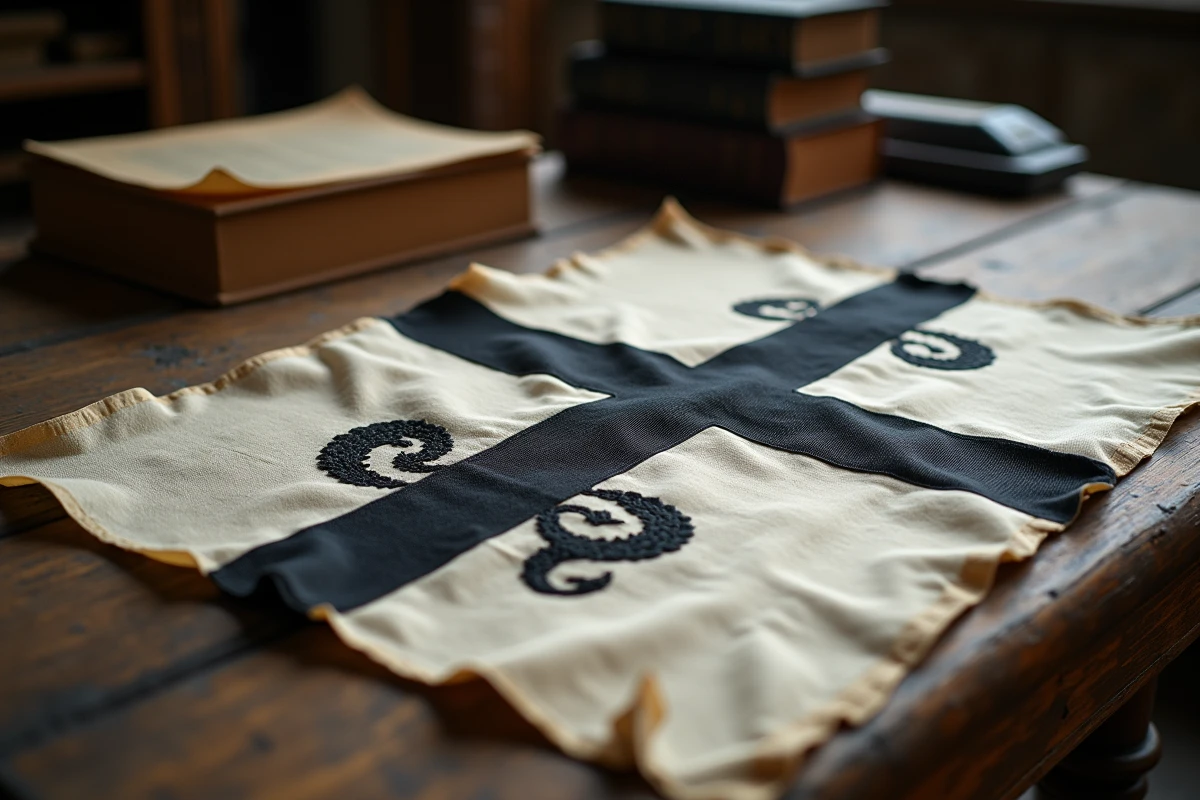
The Gwenn ha Du is not the oldest flag of Brittany. The Kroaz Du (black cross) predates it by several centuries. It is a black cross on a white background, used since the Middle Ages to identify Breton fighters, especially against French troops who displayed a white cross.
The Kroaz Du served as a military and maritime standard. The Gwenn ha Du, on the other hand, was conceived as a civil and identity flag. Both coexist today in usage, but it is the Gwenn ha Du that largely dominates in public spaces, cultural events, and tourist commerce.
A Breton Symbol That Became a Cultural and Commercial Marker
The Breton flag has transcended its original militant context. It can be found on food products, clothing, car stickers, and it waves in stadiums during matches of Stade Rennais or FC Lorient.
This massive diffusion makes it one of the most recognized regional flags in France. Its success lies in its graphic simplicity and strong identity charge. Two colors, regular stripes, an immediately identifiable ermine motif: the Gwenn ha Du functions like a logo.
The fact that historical Brittany includes Loire-Atlantique (Nantes country) fuels ongoing debates about the geographical perimeter that the flag represents. The current administrative region covers only four departments, whereas the flag symbolizes five through its nine stripes.
The Gwenn ha Du remains a living object, carried by both cultural associations and commercial brands. Its strength lies precisely in this dual reading: a real historical anchoring through the ermine spots, and a graphic modernity inherited from Morvan Marchal.