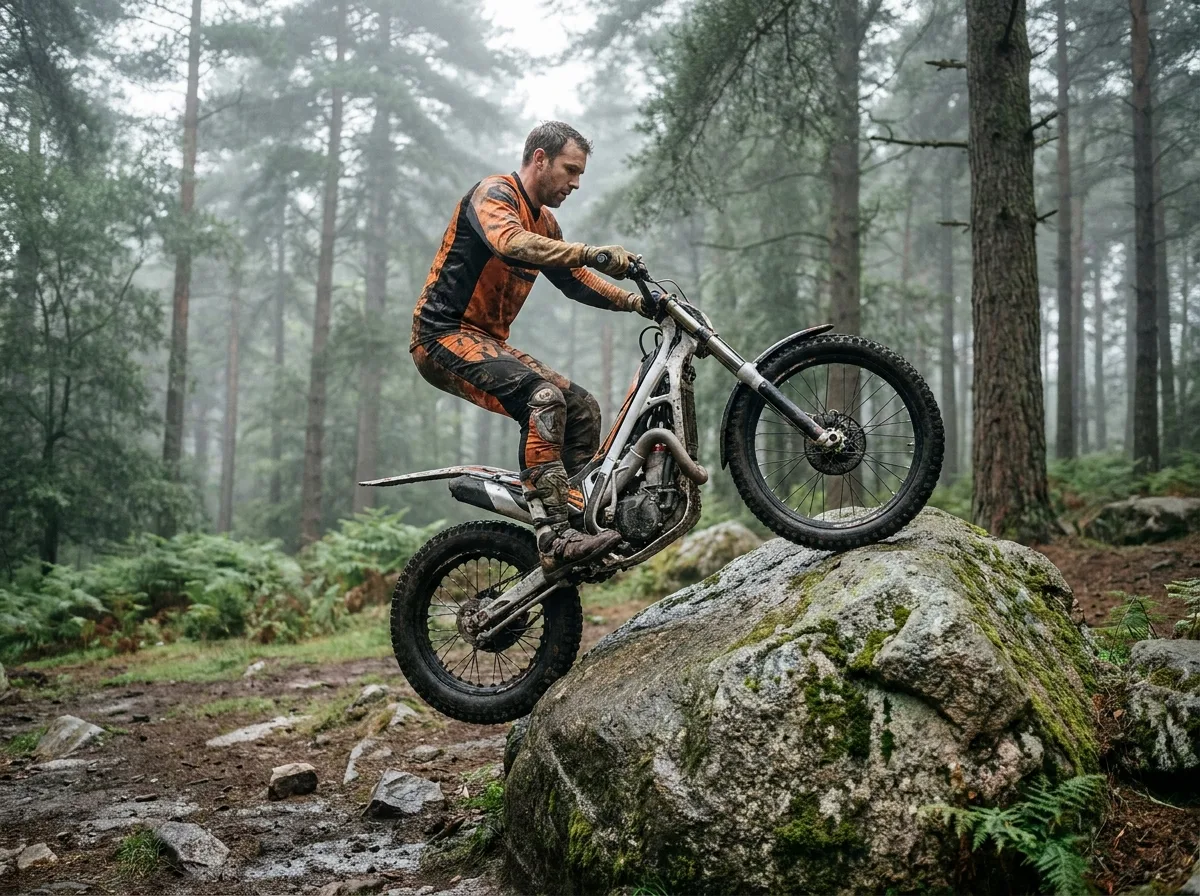
A wet rock, a clayey step, a slope covered in moss: the terrain you ride on every weekend dictates the trial bike that will suit you. Choosing a model based solely on a test in dry, flat terrain ignores half of the equation. The engine displacement, weight, engine mapping, and even the type of clutch take on a very different meaning as the rock becomes slippery or the slope steepens.
Wet terrain and rocks: what the trial bike must endure in a club
In clubs, training zones do not resemble promotional videos. The ground is often a mix of lichen-covered stones, shiny roots, and greasy soil. On this type of surface, traction does not depend solely on the tire.
The throttle response is just as important as grip. An overly aggressive engine on wet terrain causes immediate wheel spin that destabilizes the rider, especially on uphill steps. Models equipped with a soft mapping at low revs allow for power modulation without jolts.
The clutch also plays a central role. In trial, you ride as much with the clutch lever as with the throttle. On wet rock, a progressive clutch helps deliver power in small doses. A clutch that is too harsh or too abrupt turns every attempt into a slide.
If you practice regularly in a club and your region has rocky or clayey soil, also inquire about the practical aspects related to your machine’s coverage, as an issue of motorcycle insurance arises as soon as the practice becomes regular, including outside of competition.
Weight, a false friend on slippery ground
It is often said that a lightweight bike is always preferable. On dry terrain, this is true. On wet rock, a weight that is too low can become a handicap: the rear wheel bounces instead of sticking to the surface.
A good compromise lies in the lower range of intermediate displacement models. These machines retain enough mass to press the tire against the rock without tiring the arms in technical sections.
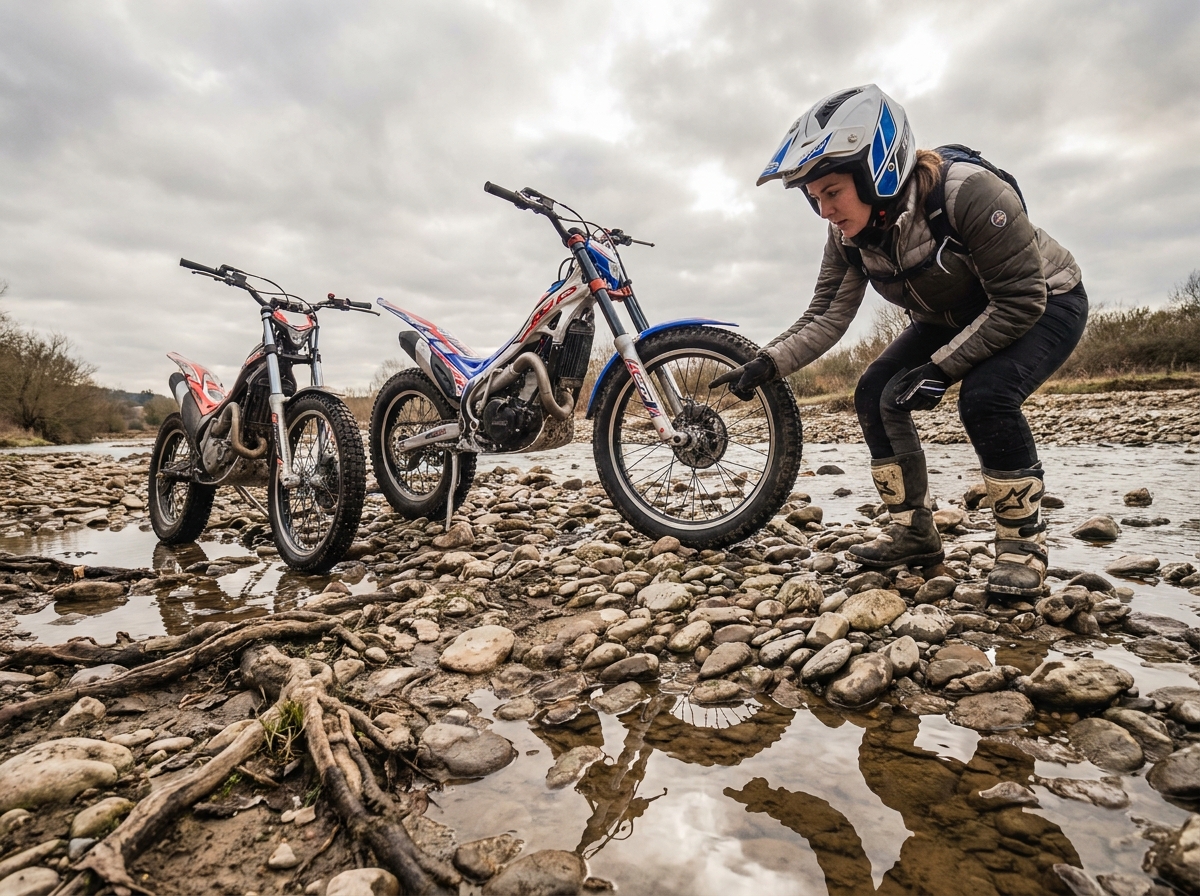
Trial bike for club riders: suitable displacement and engine speed
Have you ever noticed that an experienced rider on a small displacement bike can pass sections that a beginner on a large displacement bike fails to navigate? It’s not a question of courage; it’s a question of the engine’s usable range.
In trial, speed does not differentiate riders. The logic is reversed compared to enduro or motocross. What matters is the ability to remain stable at very low speeds, to modulate each impulse without losing balance.
- Small displacements offer a torque range usable from very low revs, making control easier on steps and wet slopes.
- Intermediate displacements are suitable for club riders who want torque reserve for large steps without sacrificing maneuverability.
- Large trial displacements are limited to specific uses (trial touring, very heavy riders) and can be penalizing on technical and slippery terrain.
Choosing your displacement based on the usual terrain, not just your size, remains the best advice a club rider can apply.
Mapping and engine modes
Several manufacturers now offer selectable mapping modes at the handlebars. The “soft” or “rain” mode reduces throttle responsiveness. On dry and grippy ground, this mode can be frustrating. On a moss-covered rock, it becomes a valuable ally.
Before buying, test the bike on the type of terrain you practice most often. A test in a parking lot says nothing about how the engine will react on a wet step on the second attempt when fatigue begins to set in.
Trial equipment constraints 2026-2027: what changes for practitioners
The French Motorcycle Federation (FFM) continues to regulate competition categories with precise power limits. But beyond competition, these developments also affect club practitioners.
Electric machines are now allowed in certain youth classes under federal conditions. This opening is no longer trivial: it reflects a trend that is already influencing practitioners’ expectations regarding silence, maintenance, and access to training areas.
Why does this change matter for an adult club rider? Because training grounds located near populated areas sometimes impose noise constraints. An electric trial bike allows riding during time slots or in places that would be closed to a combustion engine.
Helmet certification: a point to check before the season
For the 2026 and 2027 sports season, federations (including the FMB in Belgium) publish lists of certified helmets. A helmet not compliant with the current list may lead to exclusion from competition, even if the helmet bears a valid CE standard.
Check the list published by your national federation before investing in a new helmet. This document is updated regularly and may exclude models sold the previous year.
Trial in natural areas: adapting your bike to local terrain
Trial is practiced in nature, on obstacles that vary from one region to another. A practitioner from the Massif Central does not face the same constraints as a rider from Brittany or a rider from the Vosges.
- Wet granite and lichen: prioritize a rear tire with a soft compound and a very progressive clutch. The priority is traction, not tire longevity.
- Heavy and sticky clay: choose a fender with sufficient clearance to avoid clogging. A contained weight helps clear the bike when dirt accumulates.
- Dry and brittle limestone: here, protecting the engine casing and levers becomes a priority. The sharp edges of limestone quickly damage exposed parts.
- Roots and undergrowth: flexibility at low revs is crucial. Frequent restarts on loose ground require an engine that responds without harshness.
Adapting the bike’s setup to the local terrain is just as important as choosing the model itself. A good club rider changes their suspension settings, tire pressure, and sometimes their sprocket based on the season and weather.
Choosing a trial bike is not just about comparing weight and displacement. The terrain you traverse each week, the average humidity of your region, the type of rock under your tires: these concrete parameters should guide the decision. Test on your terrain, not on the dealer’s.